
WELCOME BONUS 300%
UP TO €2000 + 100
FREE SPINS
UP TO €2000 + 100
FREE SPINS
Home → Games
Casino games at HadesBet
Jacks or Better 9/6: 99.54% RTP
The full-pay Jacks or Better table pays 9 units for a full house and 6 units for a flush, producing an RTP of 99.54%. That figure stands only slightly below the 99.85% RTP of single-deck blackjack with a 3:2 payout, making it one of the highest-returning video poker variants a beginner can find. On 100 € of stakes, the expected loss is 0.46 € under flawless optimal strategy.
A short-pay 8/5 version cuts the full house and flush payouts by one unit each, lowering RTP to 97.29% and raising the house edge to 2.71%. The gap of 2.25 percentage points shows how quickly a small pay table change erodes value. For a beginner, checking the pay table before inserting money is more important than learning advanced strategy.
The 9/6 table also pays 800 units for a natural royal flush, 50 for a straight flush, and 25 for four of a kind. Three of a kind returns 3 units, two pair returns 2, and jacks or better returns 1. Compared with the positive-EV Deuces Wild full-pay table at 100.76%, the 9/6 Jacks or Better game asks less of the player because the strategy is simpler to memorise.
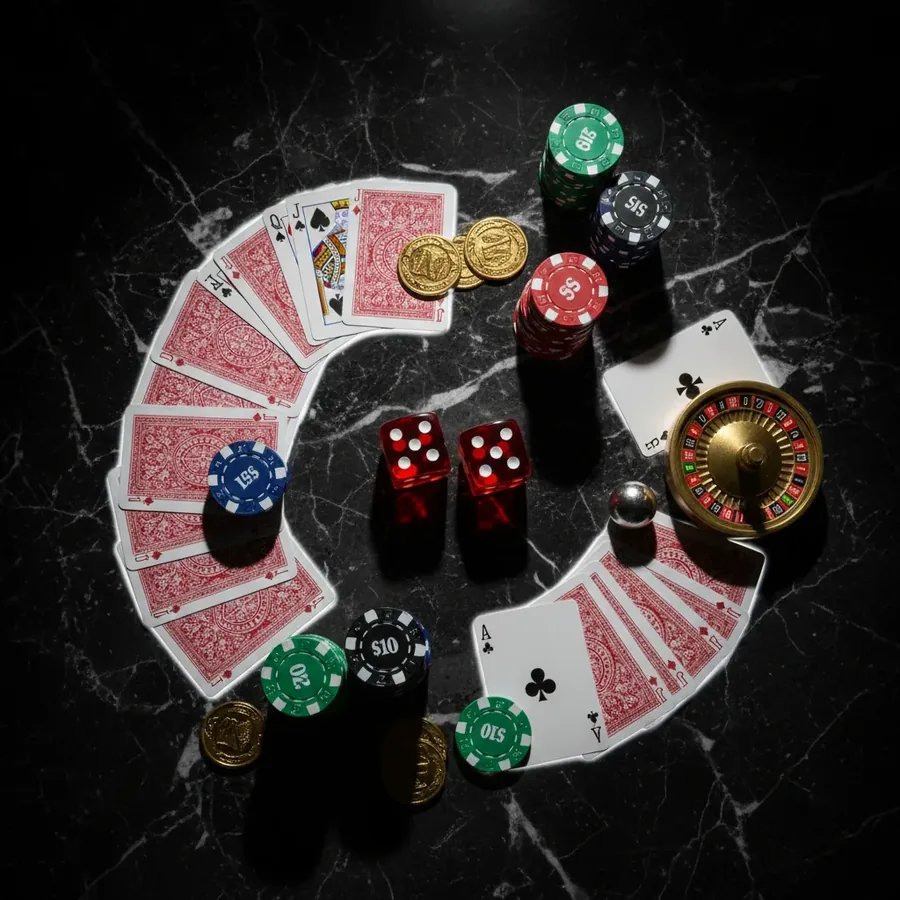
Roulette Wheels: 37 vs 38 Pockets
The European wheel has 37 pockets, numbered 1 to 36 plus a single zero, and keeps a house edge of 2.70% on every bet. That equals an RTP of 97.30% and means 100 € of stakes costs 2.70 € on average. The payouts are set as if there were 36 pockets, so the extra zero pocket creates the same edge for straight, split, street, corner, six line, dozen, column and even-money bets alike.
The American wheel adds a double zero, making 38 pockets and doubling the house edge to 5.26%, with an RTP of 94.74%. The five-number bet on 0, 00, 1, 2 and 3 is worse still: it covers 5 of 38 pockets but pays only 6:1, producing a 7.89% house edge and a 92.11% RTP. A beginner should treat that bet as a trap, because no European equivalent exists.
French roulette with La Partage applies only to even-money bets and returns half the stake when the zero hits, cutting the edge to 1.35% and lifting RTP to 98.65% on red or black, odd or even, and low or high. Inside bets in the same game remain at the European 2.70% edge. The choice between 37 and 38 pockets therefore changes the expected loss by 2.56 percentage points on every wager.
Game Shows: Sectors, Multipliers and Bet Ranges
Game shows are live-dealer formats built around a spinning wheel or a money wheel with numbered sectors, where a multiplier is applied to the bet when the wheel stops on the matching sector. Bets are placed on single numbers, groups of sectors or combinations, and the bet range sets the smallest and largest amount a player can stake on each option.
The payout structure ties every sector to a multiplier, so a single-sector bet returns a larger multiplier than a bet covering several sectors, while the probability of hitting that sector falls in proportion. A bet range names both ends, for example a minimum of 0.20 € and a maximum of 100 €, and the multiplier applies to the stake within that range.
For a beginner, the practical consequence is that the stake multiplied by the multiplier gives the gross return, so a 10 € stake on a 5x sector returns 50 € before any deduction. Choosing a wider sector group lowers the multiplier but raises the chance of a hit, which changes the variance rather than the long-run return.
Hold or Discard: Deciding on Five Cards
In five-card video poker, the player receives five cards and must hold or discard any number before a replacement draw. The full-pay Deuces Wild table returns 100.76% only with flawless optimal strategy, meaning every hold decision must match the mathematically best choice. A single deviation from strategy pushes the RTP below 100%, so the decision is the entire game.
The 9/6 Jacks or Better table pays 25 units for four of a kind, 9 for a full house and 6 for a flush. A beginner deciding which cards to hold should compare the expected value of each possible draw, not simply chase the highest payout. Keeping a low pair over four to a flush, for example, can be correct or wrong depending on the exact pay table and the number of decks in play.
The difference between a correct and an incorrect hold is measurable in RTP. Jacks or Better 9/6 returns 99.54%, while the 8/5 version returns 97.29%, a loss of 2.25 percentage points from only two changed payouts. For a beginner, learning the basic hold charts for one pay table is worth more than playing multiple variants without a fixed strategy.
Game categories at a glance
| Category | Examples | Stakes From | Highlight |
|---|---|---|---|
| Slots | Mental, Esqueleto Explosivo 2, Rise of Olympus | 0.10 EUR | thousands of titles |
| Table games | Roulette, Blackjack, Baccarat | 0.50 EUR | classic rules |
| Live casino | Speed Baccarat, Blackjack Party | 0.20 EUR | real dealers |
| Jackpot games | Mega Moolah, Divine Fortune, Age of the Gods | 0.20 EUR | progressive pools |
| Instant games | Aviator, Plinko, Mines | 0.10 EUR | fast rounds |
| Video poker | Jacks or Better, Deuces Wild | 0.25 EUR | strategy based |
Jacks or Better: Check Payout Table Before Betting
Video Poker Jacks or Better 8/5 pays a Full House 8 and a Flush 5, which produces an RTP of 97.29% and a house edge of 2.71%. The house edge is the average share of each stake the casino keeps over the long run. Cutting just 2 payout units from the full 9/6 table costs 2.25 percentage points of RTP, so 100 € of stakes costs about 2.71 € on average.
The 8/5 pay table sits between 8/6 at 98.39% and 7/5 at 96.15%, while 9/5 reaches 98.45% and 6/5 falls to 94.99%. A player who accepts 8/5 instead of 9/5 gives up 1.16 percentage points of RTP, which is roughly 1.16 € per 100 € wagered.
The 8/5 table pays a Royal Flush 800, a Straight Flush 50, Four of a Kind 25, a Full House 8, a Flush 5, a Straight 4, Three of a Kind 3, Two Pair 2 and Jacks or Better 1. The gap between 9/5 and 8/5 is 1.16 percentage points, so a 200 € session costs about 2.32 € more on the weaker table.
Dozen 2:1 Hits 12 of 37 Numbers
Roulette European uses 37 pockets numbered 1 to 36 plus 0, and a Dozen bet pays 2:1 while covering 12 numbers. The RTP is 97.30% and the house edge is 2.70%, because payouts are set as if the wheel had 36 pockets. A 10 € Dozen bet returns 20 € on a hit, against 350 € for a 10 € Straight bet at 35:1.
Covering 12 of 37 pockets gives the Dozen bet a hit frequency of about one in three spins, while a Straight covers 1 of 37. On 100 € staked on Dozens, the casino keeps 2.70 € on average, and the same 2.70 € applies to Red or Black at 1:1 and to Odd or Even at 1:1.
Roulette American carries 38 pockets and a house edge of 5.26%, so the same 100 € of Dozen stakes costs 5.26 € there instead of 2.70 €. The Dozen at 2:1 therefore returns 2:1 on a hit on both wheels, but the extra double zero raises the cost of play by 2.56 percentage points.
Split 17:1 vs Corner 8:1: Payouts Compared
A Split bet at 17:1 covers 2 of the 37 pockets on the European wheel, and a Corner bet at 8:1 covers 4 of them. Both sit on a 97.30% RTP and a 2.70% house edge, so 100 € staked on Splits or Corners costs 2.70 € on average. A 10 € Split returns 170 € on a hit, while a 10 € Corner returns 80 €.
The higher payout on the Split reflects the smaller coverage: 2 pockets against 4 for the Corner. A Street at 11:1 covers 3 pockets, a Six Line at 5:1 covers 6, and a Dozen at 2:1 covers 12, so the payout falls as the covered area grows. On 200 € of Split stakes, the average cost is 5.40 €.
Roulette American raises the same Split and Corner costs to 5.26% because of its 38 pockets. A 10 € Split there still pays 170 € on a hit, but the extra double zero lifts the average cost to 5.26 € per 100 € staked, which is 2.56 percentage points above the European figure.
Craps Pass Line: 1.41% House Edge
Craps Pass Line and Come carry an RTP of 98.59% and a house edge of 1.41% per resolved bet, with a standard deviation of 1.00 and a payout of 1:1. Per individual roll the edge is 0.42%. On 100 € of resolved Pass Line bets, the casino keeps 1.41 € on average, which is lower than the 2.70% edge on Roulette European.
The Come bet has identical maths to the Pass Line, so both share the 1.41% edge and the 1:1 payout. A 20 € Pass Line bet returns 40 € on a win, and 1,000 € of resolved bets costs about 14.10 € on average. The edge applies per resolved bet rather than per roll, which is why the per-roll figure is 0.42%.
Blackjack 6 decks, S17, DAS, DOA, 3:2 payout with basic strategy carries a 0.46% house edge, which is lower than Craps at 1.41%. A 100 € stake at Blackjack costs 0.46 € on average, so the Pass Line costs about three times as much per 100 € resolved.
The Craps Odds Bet: 0% House Edge
The Craps Pass Line bet carries an RTP of 98.59% and a house edge of 1.41% per resolved bet, while the same wager measured per roll costs just 0.42%. The Come bet offers identical maths, so a player who backs the shooter on the come-out roll faces the same 1.41% edge on every resolved decision, with a standard deviation of 1.00. On a €100 stake resolved at the Pass Line, the casino keeps €1.41 on average, leaving €98.59 returned to the player over the long run.
An odds bet placed behind the Pass Line is paid at true odds and carries no house edge at all, which is why the combined Pass Line plus odds wager dilutes the 1.41% figure downward. The Pass Line itself pays 1:1, so the base bet is the only part of the total stake that contributes to the casino's expected win. A player who backs €10 on the Pass Line and €20 in odds has €30 at risk, but only the €10 base portion is exposed to the 1.41% edge.
Standard deviation on the Pass Line is 1.00, meaning results per resolved bet swing widely around the 1.41% expected loss. Over 100 resolved bets at €10 each, the total stake is €1,000 and the expected cost is €14.10, yet individual sessions can finish far above or below that figure. The Come bet behaves the same way, so players who combine Pass Line and Come wagers face the identical 1.41% edge on both.
6 Decks vs 8 Decks: The House Edge Difference
Blackjack with six decks, dealer stands on soft 17, double after split allowed, double on any first two cards and a 3:2 payout carries an RTP of 99.54% and a house edge of 0.46% when basic strategy is followed. The 6:5 payout variant on the same six-deck game drops RTP to 98.15% and lifts the house edge to 1.85%, a swing of 1.39 percentage points. On a €10 bet, a blackjack pays €12 under 6:5 instead of €15 under 3:2, so the player loses €3 on every natural.
Single deck with classic rules and a 3:2 payout reaches an RTP of 99.85% and a house edge of just 0.15%, because fewer decks lower the edge by roughly 0.48 percentage points compared with eight decks. That advantage is often cancelled out when a casino pays only 6:5 on blackjack, which adds 1.39 percentage points back to the house. A single-deck table paying 6:5 therefore ends up worse for the player than a six-deck table paying 3:2.
Insurance in the six-deck game pays 2:1, and a regular win pays 1:1, with the 3:2 natural payout required to reach the 99.54% RTP figure. Basic strategy must be applied on every hand to achieve that number, since any deviation shifts the edge toward the casino. The gap between 0.46% on six decks and 0.15% on one deck is 0.31 percentage points, which on €1,000 of total stakes equals €3.10 of extra expected cost.
When Does Splitting Aces and Eights Make Sense?
Splitting aces and eights is a standard basic strategy play in the six-deck game that carries an RTP of 99.54% and a house edge of 0.46% when the dealer stands on soft 17, doubling after split is allowed and doubling on any first two cards is permitted. The pair of aces is split because a starting hand of soft 12 has limited value, while two separate hands each beginning with an ace can reach 21 on a ten-value card. The pair of eights is split because a hard 16 is the worst starting total against most dealer upcards.
Doubling after split is permitted in this six-deck variant, so a split ace that draws a small card can be doubled for an additional wager, and the same applies to a split eight. The 3:2 blackjack payout of €15 on a €10 bet applies to each split hand if it reaches 21 on two cards, though a split ace that draws a ten counts as 21 rather than a natural. On a €10 base bet, splitting aces commits €20 in total and each resulting hand can win €10 at 1:1 or €15 at 3:2.
The 6:5 payout variant changes the calculus, because a blackjack on a split hand pays €12 instead of €15 on a €10 bet, and the 1.85% house edge applies to the doubled stake as well. Insurance pays 2:1 and is generally declined under basic strategy, since it does not improve the 99.54% RTP figure. Splitting eights against a dealer ten remains correct in the six-deck game despite the higher variance, because standing on 16 loses more often than two hands starting at eight.
The Four Decisions in Every Blackjack Hand
A six-deck game with a 3:2 payout, dealer stands on soft 17, double after split and double on any first two cards produces an RTP of 99.54% and a house edge of 0.46% under basic strategy, while the 6:5 payout variant on the same rules falls to 98.15% RTP and a 1.85% house edge. The 1.39 percentage-point gap between those two payouts is larger than any other single rule change, and on a €10 blackjack it means €12 instead of €15. A player who faces 6:5 should treat every natural as a smaller win than the 3:2 table offers.
Late surrender allows the player to give up the hand after the dealer has checked for blackjack and lose only half the stake, improving RTP by about 0.08 percentage points. On a €10 bet that is a €5 loss instead of the full €10, and early surrender would be worth up to 0.6 percentage points but is extremely rare. The six-deck game with 3:2, S17, DAS, DOA and no surrender still reaches 99.54% RTP, so surrender is an add-on rather than a requirement.
Insurance pays 2:1 in the six-deck game and is declined under basic strategy, since taking it does not lift the 99.54% RTP figure. A regular win pays 1:1 and a blackjack pays 3:2, so the two payouts that matter for the 0.46% house edge are the natural and the standard win. Doubling on any first two cards and doubling after split are both required to reach the 99.54% figure, and removing either rule pushes the edge above 0.46%.
Variance at the Table: 1:1 vs 35:1
Roulette French with La Partage returns half the stake on even-money bets when zero hits, giving those wagers an RTP of 98.65% and a house edge of 1.35%, while inside bets on the same wheel sit at 97.30% RTP and 2.70%. A straight-up bet pays 35:1 and a split pays 17:1, yet both carry the higher 2.70% edge because La Partage does not cover inside bets. On a €10 straight bet, the win is €350, but the expected cost per €100 staked is €2.70 rather than €1.35.
Roulette American uses 38 pockets with both 0 and 00, which drops RTP to 94.74% and lifts the house edge to 5.26%, nearly four times the 1.35% available on French even-money bets. The Five Number Bet covering 0, 00, 1, 2 and 3 pays 6:1 and carries an RTP of 92.11% and a house edge of 7.89%, the worst wager on the American wheel. A €10 Five Number Bet returns €60 on a win, but the 7.89% edge means €100 of stakes costs €7.89 on average.
Sic Bo special bets range from 81.48% to 92.13% RTP, with a house edge between 7.87% and 18.52% across the group, so the Single Number bet at 7.87% is the best of them and the Specific Double at 18.52% is the worst. Payouts run from 180:1 on a Specific Triple down to 1:1 on a Single Number, yet the 1:1 version still carries a 7.87% edge. The Baccarat Player Pair and Banker Pair side bet pays 11 for 1 and carries an RTP of 89.64% and a house edge of 10.36%, far above the main game.
Contact
Live - online chat
Banking









Providers












HadesBet 2026